 Por que a erupção de um vulcão, às vezes, cria um relâmpago?Fotografado aqui o Vulcão Sakurajima, no sul do Japão, estava em plena erupção, no início do mês passado.As bolhas de magma são tão quentes que seu brilho se espalha quando rocha líquida explode através da superfície terrestre, vindo de baixo.
A imagem é particularmente interessante pelos raios captados próximos ao cume do vulcão.O motivo da ocorrência de raios em tempestades comuns ainda é um tópica de pesquisa, e a causa dos raios em vulcões é ainda mais obscura. Certamente, relâmpagos ajudam a arrefecer áreas de cargas elétricas opostas, porém separadas. Uma hipótese é que as bolha de magma catapultadas ou cinza vulcânica tem elas mesmas carga elétrica, e por sua movimentação, criam essas áreas separadas. Outros episódios de relâmpagos vulcânicos podem ser facilitados por colisões de indução de carga na poeira vulcânica. Relâmpagos geralmente ocorrem o tempo todo em algum lugar da Terra, à razão de mais de 40 vezes por segundo.
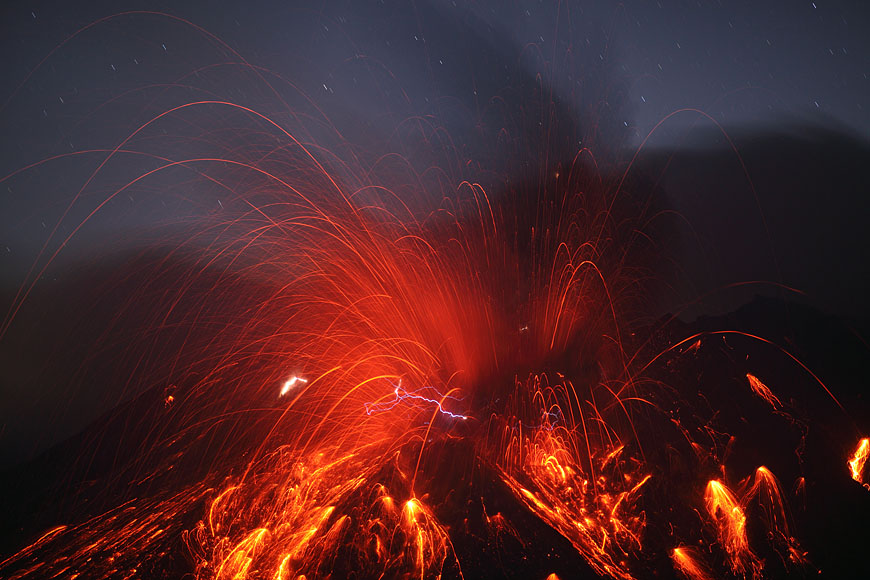
Why does a volcanic eruption sometimes create lightning? Pictured here, the Sakurajima volcano in southern Japan was caught erupting early last month. Magma bubbles so hot they glow shoot away as liquid rock bursts through the Earth's surface from below. The image is particularly notable, however, for the lightning bolts caught near the volcano's summit. Why lightning occurs even in common thunderstorms remains a topic of research, and the cause of volcanic lightning is even less clear. Surely, lightning bolts help quench areas of opposite but separated electric charges. One hypothesis holds that catapulting magma bubbles or volcanic ash are themselves electrically charged, and by their motion create these separated areas. Other volcanic lightning episodes may be facilitated by charge-inducing collisions in volcanic dust. Lightning is usually occurring somewhere on Earth, typically over 40 times each second.
Por que a erupção de um vulcão, às vezes, cria um relâmpago?Fotografado aqui o Vulcão Sakurajima, no sul do Japão, estava em plena erupção, no início do mês passado.As bolhas de magma são tão quentes que seu brilho se espalha quando rocha líquida explode através da superfície terrestre, vindo de baixo.
A imagem é particularmente interessante pelos raios captados próximos ao cume do vulcão.O motivo da ocorrência de raios em tempestades comuns ainda é um tópica de pesquisa, e a causa dos raios em vulcões é ainda mais obscura. Certamente, relâmpagos ajudam a arrefecer áreas de cargas elétricas opostas, porém separadas. Uma hipótese é que as bolha de magma catapultadas ou cinza vulcânica tem elas mesmas carga elétrica, e por sua movimentação, criam essas áreas separadas. Outros episódios de relâmpagos vulcânicos podem ser facilitados por colisões de indução de carga na poeira vulcânica. Relâmpagos geralmente ocorrem o tempo todo em algum lugar da Terra, à razão de mais de 40 vezes por segundo.
Why does a volcanic eruption sometimes create lightning? Pictured here, the Sakurajima volcano in southern Japan was caught erupting early last month. Magma bubbles so hot they glow shoot away as liquid rock bursts through the Earth's surface from below. The image is particularly notable, however, for the lightning bolts caught near the volcano's summit. Why lightning occurs even in common thunderstorms remains a topic of research, and the cause of volcanic lightning is even less clear. Surely, lightning bolts help quench areas of opposite but separated electric charges. One hypothesis holds that catapulting magma bubbles or volcanic ash are themselves electrically charged, and by their motion create these separated areas. Other volcanic lightning episodes may be facilitated by charge-inducing collisions in volcanic dust. Lightning is usually occurring somewhere on Earth, typically over 40 times each second.
quarta-feira, 10 de fevereiro de 2010
O vulcão Sakurajima
Por que a erupção de um vulcão, às vezes, cria um relâmpago?Fotografado aqui o Vulcão Sakurajima, no sul do Japão, estava em plena erupção, no início do mês passado.As bolhas de magma são tão quentes que seu brilho se espalha quando rocha líquida explode através da superfície terrestre, vindo de baixo.
A imagem é particularmente interessante pelos raios captados próximos ao cume do vulcão.O motivo da ocorrência de raios em tempestades comuns ainda é um tópica de pesquisa, e a causa dos raios em vulcões é ainda mais obscura. Certamente, relâmpagos ajudam a arrefecer áreas de cargas elétricas opostas, porém separadas. Uma hipótese é que as bolha de magma catapultadas ou cinza vulcânica tem elas mesmas carga elétrica, e por sua movimentação, criam essas áreas separadas. Outros episódios de relâmpagos vulcânicos podem ser facilitados por colisões de indução de carga na poeira vulcânica. Relâmpagos geralmente ocorrem o tempo todo em algum lugar da Terra, à razão de mais de 40 vezes por segundo.
Why does a volcanic eruption sometimes create lightning? Pictured here, the Sakurajima volcano in southern Japan was caught erupting early last month. Magma bubbles so hot they glow shoot away as liquid rock bursts through the Earth's surface from below. The image is particularly notable, however, for the lightning bolts caught near the volcano's summit. Why lightning occurs even in common thunderstorms remains a topic of research, and the cause of volcanic lightning is even less clear. Surely, lightning bolts help quench areas of opposite but separated electric charges. One hypothesis holds that catapulting magma bubbles or volcanic ash are themselves electrically charged, and by their motion create these separated areas. Other volcanic lightning episodes may be facilitated by charge-inducing collisions in volcanic dust. Lightning is usually occurring somewhere on Earth, typically over 40 times each second.


Assinar:
Postar comentários (Atom)
Nenhum comentário:
Postar um comentário